High-Quality DIY: The Nissan Titan XD Lift Pump Rebuild Kit That Will Save You Hundreds
Fleece Performance Engineering’s affordable, common-sense fuel system solution provides the parts (and detailed instructions) every Titan XD owner needs to rebuild their lift pump.
The diesel-powered Nissan Titan XD is a fairly rare, short production run truck. Equipped with a 310hp 5.0L Cummins V-8, it was designed as a ‘tweener option to bridge the gap between half-ton and ¾-ton pickups, but it was only on the assembly line for four years thanks to low sales figures. Many of you even forgot it ever existed… Fleece Performance Engineering didn’t forget. In fact, the company with a reputation for developing problem-solving products decided to roll up its sleeves and tackle one of the XD Cummins platform’s biggest issues: lift pump failure. Its high-quality, common-sense solution provides the parts (and detailed instructions) a Titan XD owner needs to rebuild their own fuel pump—and save hundreds of dollars in the process.
What’s In The Box
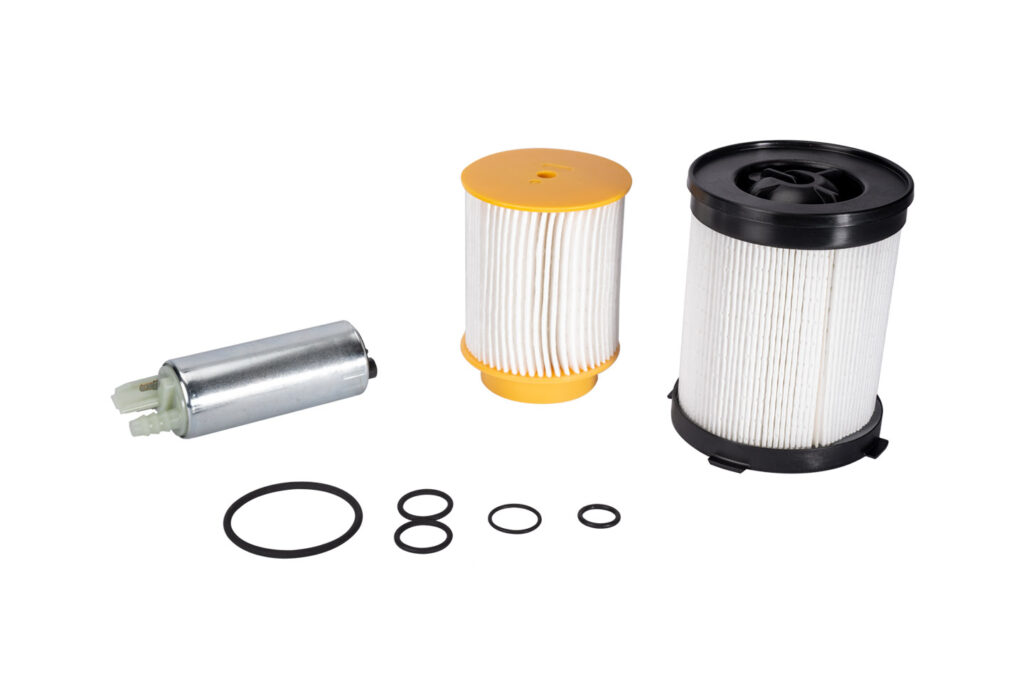
This carefully selected assortment of parts was assembled to be a direct replacement, OEM-quality rebuild kit for the lift pump supplying fuel to your Cummins-powered Nissan Titan XD. The comprehensive kit comes with an OE gerotor pump, the O-rings required to reseal the fuel return passthrough as well as the lower and upper fuel filter assemblies, and Fleetguard under bed and under hood fuel filters. With a retail price of $439.95, it’s also designed to save you hundreds over what you’ll pay at your local Nissan dealer, which only offers the entire replacement assembly, at a cost of $1,100 to $1,400…
A Minimal-Mess Removal
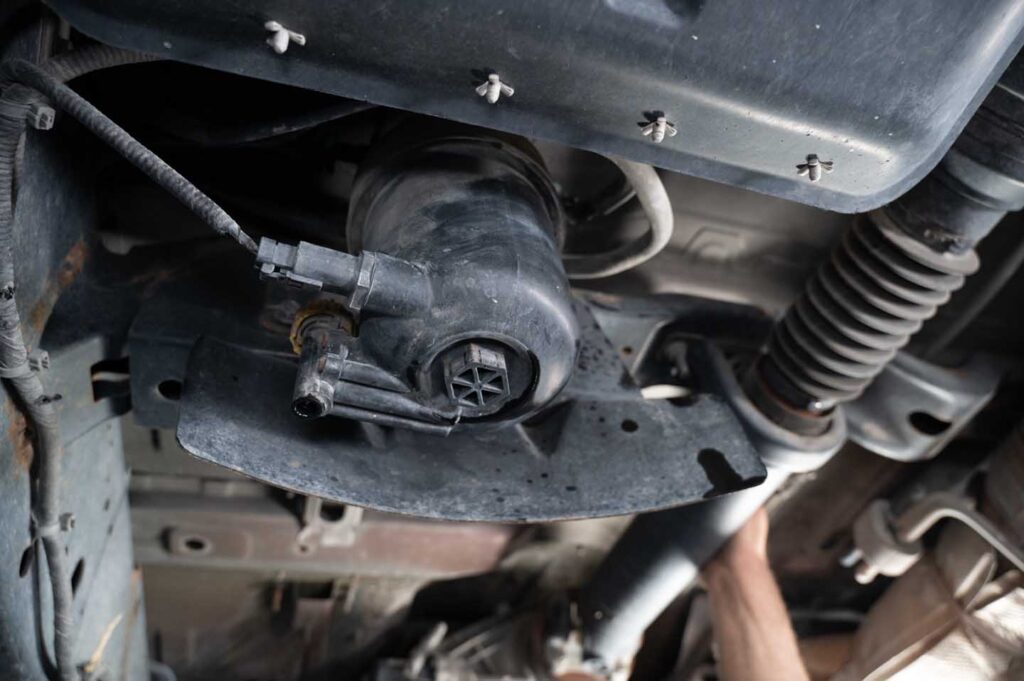
At first glance, the modular lift pump assembly aboard the Nissan Titan XD is reminiscent of what you’ll find under a late-model Ford 6.7L Power Stroke. Prior to its removal, the under bed filter must be drained and dropped, and the chassis harness connectors disconnected for the fuel pump’s power and water-in-fuel (WIF) sensor. To limit the mess during the install, Fleece supplies two quick-disconnect plugs, which install in the factory fuel lines to keep fuel from leaking. From there, the nuts and bolts that tie the lift pump in with the under bed crossmember can be broken free and the assembly removed.
Disassembly Of The Upper Fuel Filter Assembly
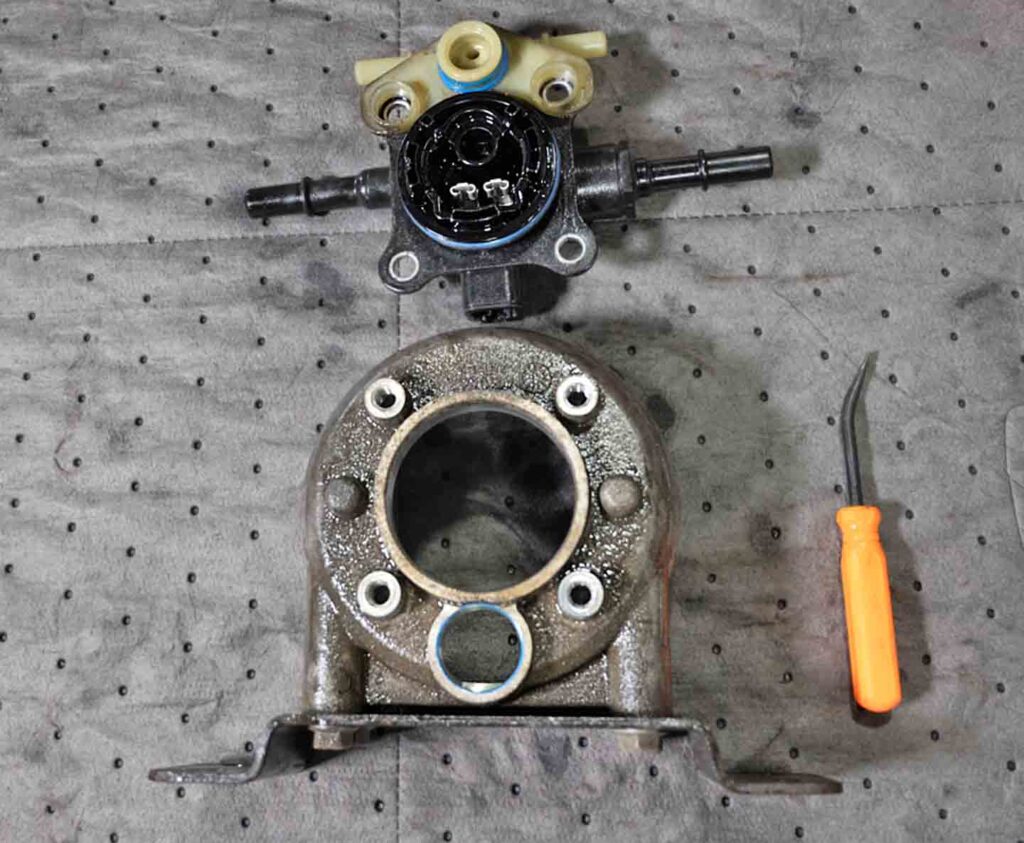
Using a T25 Torx bit, the screws that join the fuel pump housing to the filter assembly are removed, and separating the upper portion of the filter housing from the lower section calls for a 10mm socket or wrench. After gently prying the upper filter assembly (i.e. the head) free from the upper filter housing, the plastic fuel return passthrough (shown, top) is carefully removed from the upper filter assembly. Here, it’s important to take note of the location and orientation of the metal plate that gets reused during reassembly.
Fresh O-rings & Reassembly
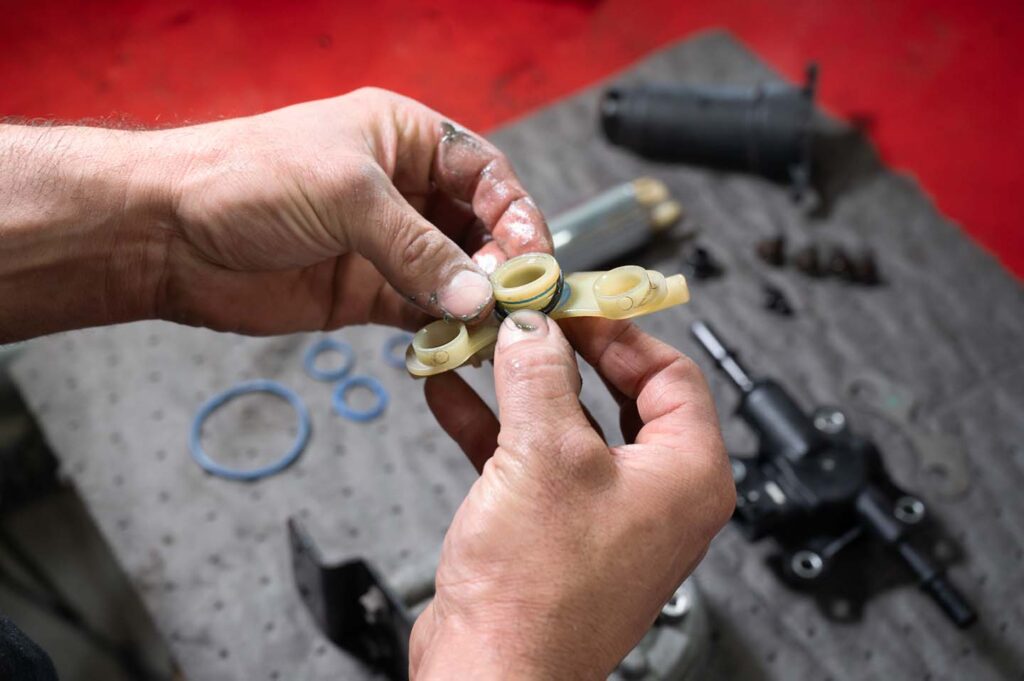
Fleece supplies all five O-rings required to perform the rebuild. Three O-rings are replaced on the plastic fuel return passthrough (shown), and another O-ring replaces the seal present on the underside of the upper filter assembly. Then the factory quick-disconnect fitting located on the side of the upper fuel filter assembly is removed, treated to a new O-ring, and gets reinstalled (via 19mm socket, or wrench). After that, the fuel return passthrough can be hand-pressed back into the upper filter assembly, followed by the upper filter assembly being pressed back onto the fuel filter housing.
Gerotor Pump
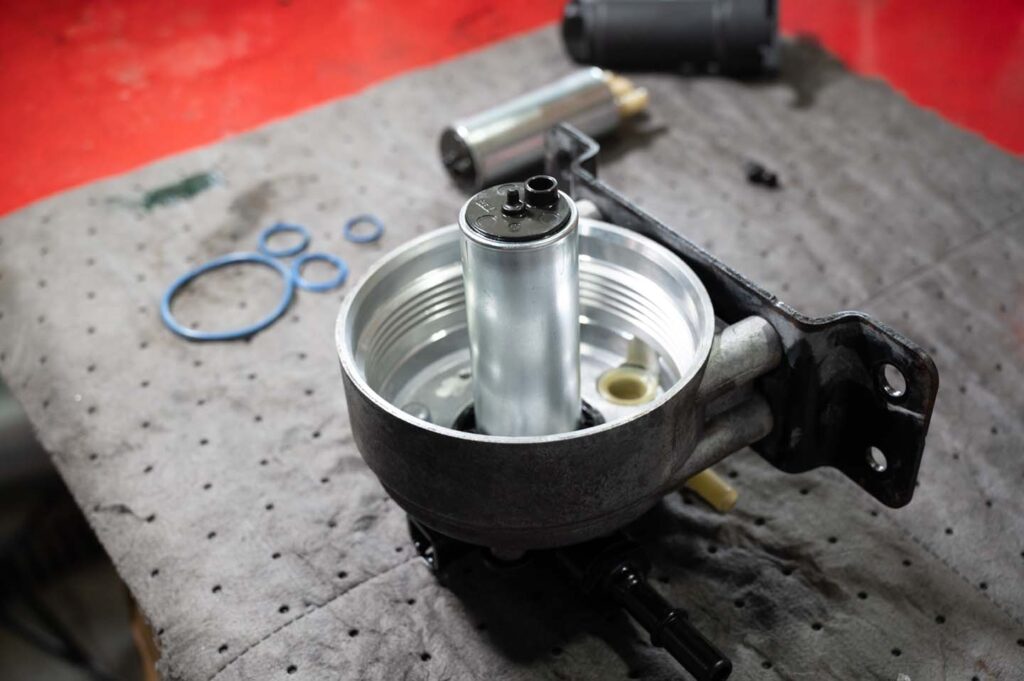
The gerotor pump employed in diesel model Nissan Titan XD’s is the same one you’ll find in Fleece’s renowned PowerFlo in-tank lift pumps for the 5.9L/6.7L Cummins, Duramax, and Power Stroke platforms. With this being the case, the supplied gerotor pump is a direct replacement and installs in the exact same manner in the underside of the Titan’s factory upper filter assembly. With its electrical connectors lined up with the terminals on the upper filter assembly, it can be carefully hand-pressed into place until fully seated (shown). After that, the fuel pump housing can be reinstalled over the pump using the aforementioned T25 Torx screws.
Under Bed Fuel Filter
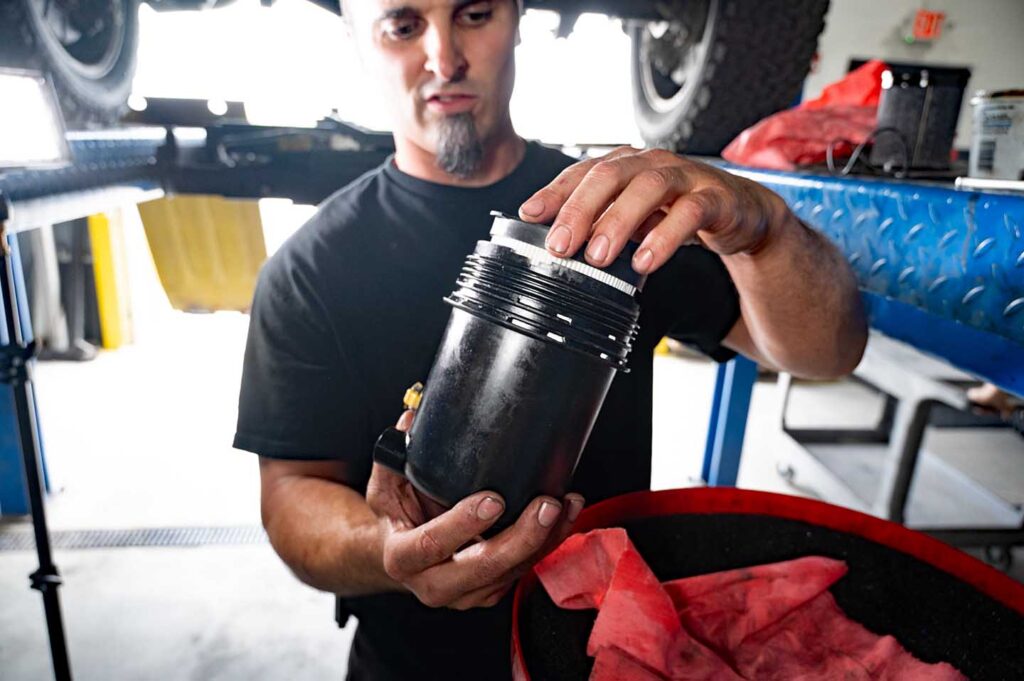
From there, the supplied under bed Fleetguard fuel filter can be installed in the lower fuel filter housing. To lock the filter into place within the housing, it must be rotated clockwise. Once the new under bed filter is in the housing, the included O-ring is installed in the second groove from the bottom. With the filter and O-ring in place, the lower fuel filter housing can be rejoined with the main filter housing and fuel pump assembly using a 28mm socket or wrench. Then the WIF sensor can be reinstalled in the lower fuel filter housing using a 19mm socket or wrench.
Under Hood Fuel Filter
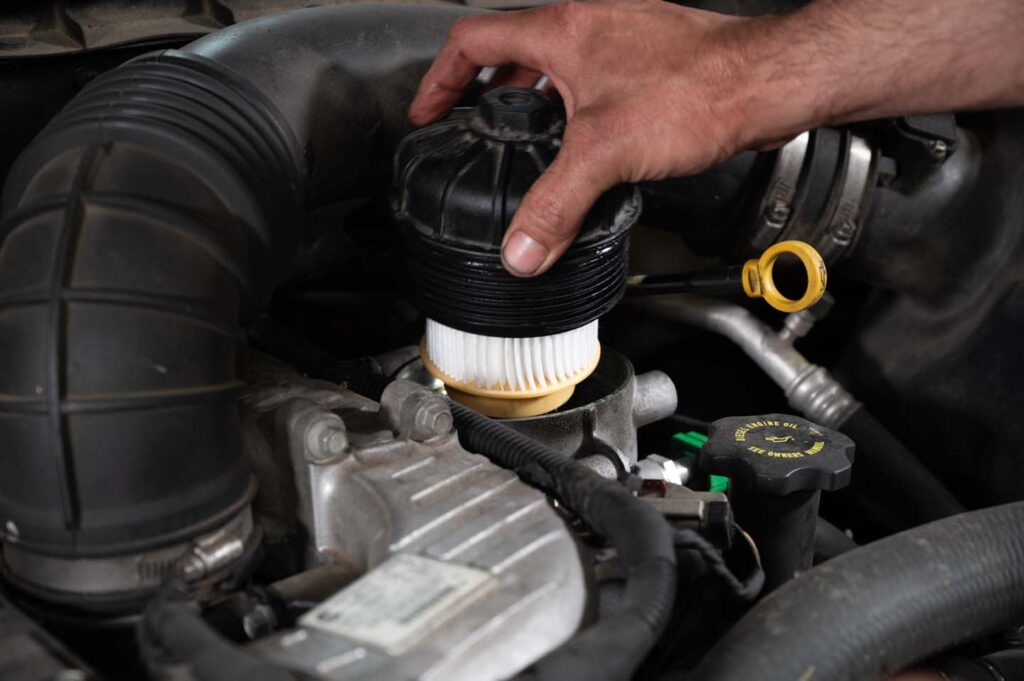
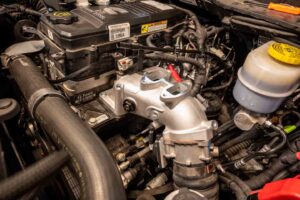
Up under the hood, the 5.0L Cummins’ secondary fuel filter gets replaced with a Fleetguard unit, which is also supplied in the Fleece rebuild kit. Take care that the included O-ring is coated in fresh diesel fuel (or grease) and that it’s positioned in the same location on the filter cap as the previous O-ring. The last order of business is crucial to long lift pump life and it entails properly priming the fuel supply system. It calls for the supply line coming off the under bed filter assembly to be disconnected, its fitting equipped with a ½-inch rubber hose, with that ½-inch hose being positioned in a 5-gallon bucket. Keying “On” the ignition without starting the engine, the fuel pump should be allowed to run for 30-60 seconds, until fuel flows freely into the bucket. After that, reinstall the factory feed line and key the ignition on for an additional 10-15 seconds prior to starting the engine.
Written by Mike McGlothlin